Let's talk about what stress actually does to your body
Chronical stress doesn't just make you tired. It rewires your nervous system, floods your body with cortisol, and literally narrows your brain's access to the parts that feel pleasure. Your desire doesn't disappear because you stopped loving your partner or yourself. It disappears because your body is in survival mode, and survival mode has no bandwidth for sensation.
Here's the part most people don't realize: you can't think your way out of this. Willpower doesn't work. Motivation doesn't work. What works is slowly, patiently signaling to your nervous system that it's safe to relax again. And sometimes, that signal needs to come through pleasure itself.
Why stress kills intimacy first
When you're under prolonged stress, your body prioritizes threat detection over sensation. Your parasympathetic nervous system, which governs arousal and pleasure, gets sidelined by your sympathetic system, which governs fight-flight-freeze. The result: you feel touched out, disinterested, or even repulsed by the idea of sex. This is not a personal failure. This is physiology.
The paradox is that pleasure is actually one of your best tools for downregulating stress. But you have to approach it differently when you're in recovery mode. You can't force arousal. You can't manufacture desire. What you can do is create conditions where your nervous system feels safe enough to accidentally stumble into it.
That's where lemon clitoral vibrators come in.
Why lemon vibrators work during stress recovery
The suction-based design of a lemon vibrator is uniquely suited to stress recovery for three reasons.
First, it doesn't require much from you. Traditional vibrators demand rhythm, engagement, and a certain level of mental presence. A lemon sucker works through gentle, consistent pulsing. You don't have to perform. You don't have to orchestrate your own pleasure. You just have to receive.
Second, it meets your nervous system where it is. The gentle, rhythmic pulsing of a lemon vibrator mimics the kind of repetitive input your brain needs to shift out of stress mode. It's not aggressive stimulation that demands immediate response. It's a slow signal that says: this is safe, this feels good, you can relax.
Third, it bypasses the mental blocks that stress creates. When you're stressed, your brain is busy narrating everything: am I doing this right, am I taking too long, should I be wanting this more, why am I thinking about the grocery list. The focused, almost meditative sensation of a lemon clitoral vibrator can quiet that noise. You get out of your head and back into your body.
How to start if desire feels completely absent
If you haven't felt any desire in months, don't start by expecting an orgasm. That's too much pressure. Instead, think of this as nervous system retraining.
Set aside 15 minutes when you're alone, your phone is away, and you won't be interrupted. No expectation of outcome. You're not trying to come. You're not trying to feel sexy. You're just exploring sensation.
Start with the lowest setting on your lemon vibrator. Run it over your arm or your inner thigh first. Let your body remember what gentle stimulation feels like without the pressure of it having to lead anywhere. Some people spend three to five sessions just doing this before they touch their clitoris at all.
When you do move to your clitoris, you might feel nothing. That's fine. You might feel something for five seconds and then it goes away. Also fine. You're rewiring neural pathways that stress has temporarily shut down. This takes time.

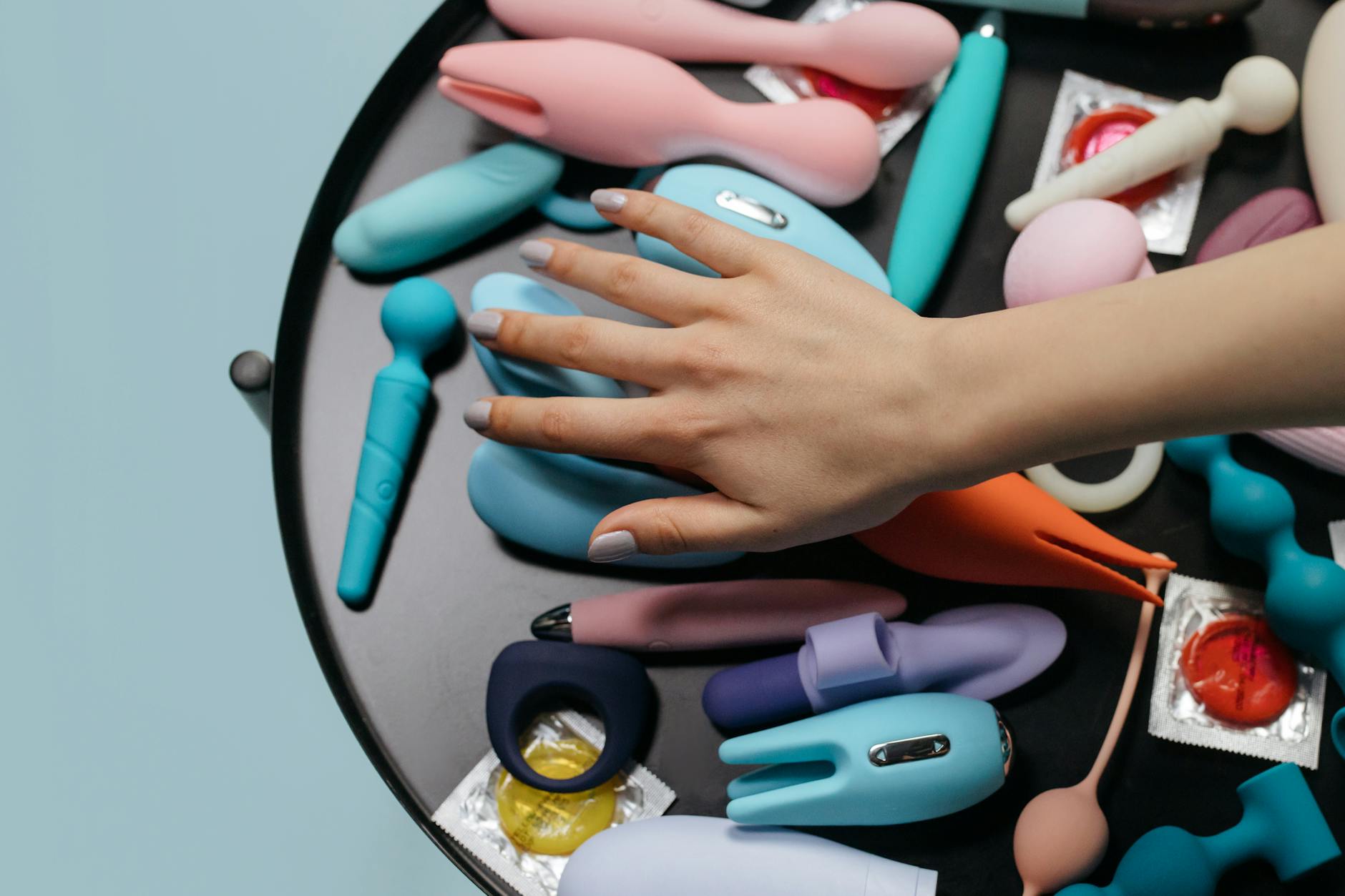
Photo by cottonbro studio on Pexels
Building back into partnered intimacy
Here's the conversation you need to have with your partner before you get here: rebuilding desire is not a performance. It's a process. Your partner cannot fix this by trying harder or being more patient. Only you can signal to your nervous system that it's safe.
But your partner can stop adding pressure. They can stop asking if you're in the mood. They can stop taking your lack of desire as rejection. That's the real work.
Many of my clients find that solo pleasure with a lemon vibrator actually rebuilds partnered intimacy faster than trying to force it with a partner. Why? Because there's zero pressure, zero eyes on you, zero concern about their experience. You get to remember what pleasure feels like on its own terms.
Once you've reconnected with solo sensation, partnered sex can return naturally. And when it does, many couples find it's richer than it was before the stress, because you've both learned that desire can't be forced, only invited.
The timeline is not linear
Stress recovery is not a straight line. You might have a week where sensation returns, and then another week where you feel nothing again. This doesn't mean you're failing. This means your nervous system is still learning that the threat has passed.
Expect plateaus. Expect setbacks. Expect days when you touch your lemon vibrator and feel nothing, and then suddenly, a week later, you have your strongest orgasm in months. Your body is recalibrating. Give it grace.
When to add intensity back in
You'll know you're ready to increase intensity when pleasure starts feeling like something you want, not something you're obligated to pursue. There's a shift in your body's signal. The sensation stops feeling neutral or effortful and starts feeling actually good.
That's when you can experiment with higher settings on your lemon vibrator, or try the patterns that maybe felt too intense before. But you'll also notice that you don't need maximum intensity to feel good anymore. Stress recovery often brings a surprising gift: you become more sensitive to gentler stimulation, which means fuller pleasure with less work.
What partners can actually do
If you're rebuilding intimacy in a relationship, your partner's job is not to fix you or to push harder. Their job is three things: stop adding pressure, handle their own anxiety about the distance, and express genuine interest in your experience without making it about them.
This might sound like: "I love you and I'm not going anywhere. Take whatever time you need. What can I do to make you feel more supported?" Not: "When do you think you'll be interested in sex again?" One creates safety. The other creates more stress.
FAQ: Rebuilding desire after prolonged stress
Is it normal to have zero sexual desire after months of stress?
Completely normal. Your body entered crisis mode and shut down systems that aren't necessary for immediate survival. Desire is one of the first things to go and often one of the last things to come back. This doesn't mean your sexuality is broken. It means your nervous system is doing exactly what it's supposed to do during sustained threat.
Can a lemon vibrator help me orgasm if I've never had one?
Maybe. For some people, stress has blocked orgasm entirely. For others, sensation returns before orgasm does. If you've never orgasmed, a lemon clitoral vibrator is actually an excellent starting point because the suction design creates very focused stimulation. But take the pressure off the outcome. Use it to reconnect with sensation first. Orgasm may follow, or it may not, and both are okay.
How long does it usually take to feel desire again after prolonged stress?
There's no standard timeline. It depends on how long the stress lasted, whether the stressor has actually ended, your general nervous system sensitivity, whether you're in therapy or getting other support, and your individual physiology. Some people feel shifts in two weeks. Others take months. Both are within normal range.
Should I tell my partner I'm using a lemon vibrator to rebuild desire?
That depends on your relationship norms. Some couples find transparency around self-pleasure helpful and connective. Others keep solo pleasure private, and that's equally valid. There's no rule. Do whatever feels honest to you and safe in your relationship.
What if my partner is also stressed and has lost desire?
This is actually really common. Two stressed nervous systems in one household often feed each other's anxiety. The most loving thing you can both do is acknowledge that you're both in survival mode and that pressure from each other won't help. Sometimes the best gift in this phase is giving each other space to heal separately, without sexual expectation, and reconnecting when you're both ready.
Can lemon vibrators help if stress is still ongoing?
Yes and no. A lemon vibrator can help you access pockets of pleasure even during ongoing stress, which is genuinely valuable for your nervous system. But if the stressor itself hasn't diminished, full desire recovery will be limited. Ideally, you're addressing the stress itself (therapy, boundary-setting, reducing work hours, whatever applies) while also using pleasure as a tool for nervous system regulation. Both matter.
The bigger picture
Rebuilding intimacy after prolonged stress is not a solo project. You need to address the stress itself, not just its symptoms. If work is the stressor, something has to change about work. If the relationship itself caused the stress, that needs direct conversation. If grief or loss or health crisis caused it, you might need professional support to process it.
But while you're doing all that deeper work, a lemon vibrator can be one of your gentlest tools for signaling to your nervous system that pleasure is still possible. That you're still here. That your body still deserves to feel good.
Start small. Expect nothing. Let sensation be exactly what it is. Your desire will return when your nervous system feels safe enough to let it. And when it does, it'll feel like coming home.